
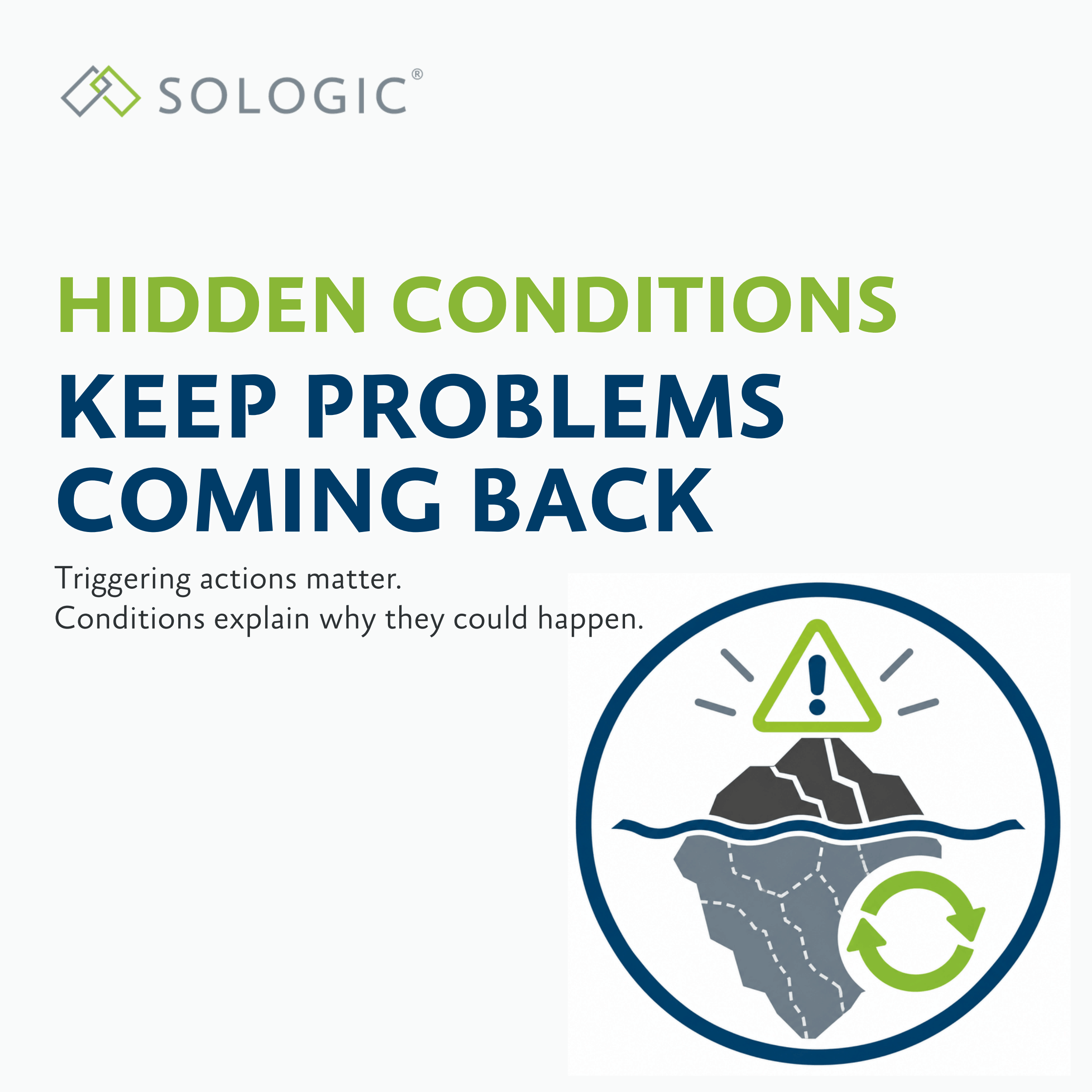
In complex operations, failures rarely result from one isolated decision. Failures usually happen because the conditions that allowed the failure were never fully understood or changed.
That gap is one reason so many operational problems, safety incidents, quality issues, and production disruptions recur. When teams are trying to understand the root causes of an accident, defect, outage, or operational failure, they naturally focus on the triggering action closest to the event. Someone skipped a step. A part failed. A valve was opened. Those triggering actions matter. But they are rarely the full explanation.
Strong problem solving requires looking at both the triggering action and the conditions that made that action possible, more likely, or difficult to avoid.
What Root Cause Analysis Is Really Trying to Do
When it comes to problem solving many organisations use various forms of Root Cause Analysis (RCA). RCA is a structured method to understand how and why an incident, error, failure, or outcome happened so you can reduce the risk of it happening again.
RCA is not about finding the one cause of an issue. Most problems happen because several things were true at the same time. Said another way: problems happen when conditions allow a triggering event to occur. The goal of an RCA report is about building a clear explanation of how conditions and triggering events come together to produce an outcome.
Event, Triggering Action, and Condition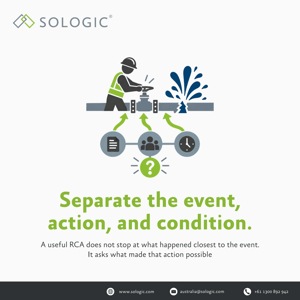
A useful way to think about an incident while conducting an RCA is to separate it into three parts.
Event: The thing that happened or the outcome you are investigating.
Triggering Action: The visible action closest to the event.
Condition: A factor that made the triggering action possible, more likely, or harder to avoid.
Finding the causes of an event depends on understanding how conditions interacted with triggering action.
Persistent vs Temporary Conditions
One important distinction is that not all conditions are persistent or systemic. Some conditions are temporary and situational. Others are long-standing parts of the system.
Rain making a walkway slippery is a temporary condition. An uneven floor surface may be a long-standing condition. A production deadline creating unusual time pressure may be a situational condition. Chronic understaffing may be a persistent systemic condition.
Strong investigations distinguish between temporary conditions and persistent systemic conditions because corrective actions should match the level of risk and recurrence potential.
How Triggering Actions and Conditions Work Together
Conditions create potential. The triggering action activates that potential. For example, a gas leak creates potential. A spark activates it.
The same idea applies in operations. Imagine an out-of-spec product is made on a production line. The triggering action might have been that an operator skipped a verification step before starting the line. And the conditions might be:
• The verification steps are poorly defined or easy to skip
• The interface does not make the step obvious
• The team is under production time pressure
• There is no immediate alarm or feedback when the step is missed
A shallow analysis might conclude that the cause of the out of spec part was operator error and the solution is to retrain the operator. A deeper analysis would look at the conditions and how those might be changed to prevent future errors.
Why Investigations Miss Hidden Conditions
Most investigations are done quickly or are simply paperwork. When something goes wrong, the pressure is to restore operations, close the issue, and move on. That often leads to a familiar pattern:
• Identify the triggering action
• Assign a cause
• Apply a fix
The fix usually targets the person closest to the event:
• Retrain the operator
• Reinforce the procedure
• Remind the team
• Add more supervision
Sometimes those actions are necessary. But by themselves, they rarely change the conditions surrounding the work.
People work inside systems. Those systems include procedures, tools, equipment, interfaces, staffing levels, workload, time pressure, communication, training, incentives, and management expectations. If an investigation recommends more training, it’s likely missing the system surrounding the triggering action. Instead of asking “Who made the mistake?” Try asking “What conditions made the mistake likely to happen?”
7 Questions to Ask to Uncover Conditions in an RCA Investigation
To get to actual root causes, you need to look beyond the triggering action and ask questions that reveal the situation around the work, such as:
- What was happening at the time?
Look for workload, time pressure, interruptions, competing priorities, or unusual circumstances. - What information was available?
Consider what people could see, hear, access, or reasonably know in the moment. - What made the triggering action possible?
Review procedures, tools, equipment, interfaces, layout, staffing, and work design. - What made the correct action hard to take?
Identify friction, ambiguity, missing feedback, unclear expectations, or practical obstacles. - What made the incident likely to happen?
Consider fatigue, habit, production targets, unclear ownership, weak controls, or incentives. - What evidence shows the conditions exist?
Use records, observations, logs, interviews, photos, videos, and data. - Would changing or removing the condition reduce risk?
This helps test whether the condition is worth addressing through corrective action.
For a deeper look at questions to ask after an incident see: 20 RCA Interview Questions That Uncover Real Causes
How to Fix Conditions So Problems Stay Fixed
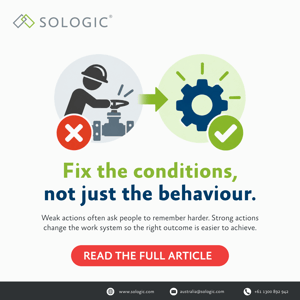
To fix problems so they have a high likelihood of staying fixed put corrective actions in place that change the conditions surrounding the work. Examples include redesigning the process, improving system controls, simplifying the task, improving visibility, adding feedback mechanisms, or reducing unnecessary pressure. The goal is to create conditions that better support desired outcomes under real operating pressure.
The Shift from Blame to Systems Thinking
Triggering actions often point to people. Conditions reveal the system.
If an analysis stops at the triggering action, it tends to focus only on behaviour. That often leads to blame, even when blame is not the intent.
When the analysis includes conditions, the conversation changes. The focus shifts from “Who failed?” to “What made this outcome possible?” That shift improves solution quality, investigation credibility, team engagement, and long-term performance.


Have something to add?
Share your experience, perspective or thoughts on the topic below.